A successful webinar on addressing urban heat islands for equitable climate resilience
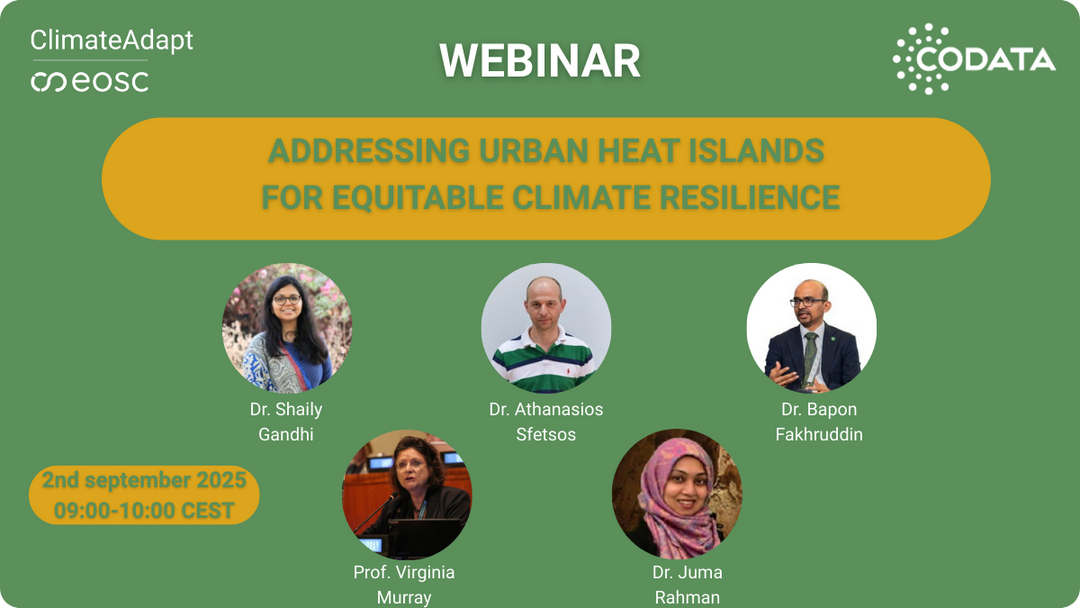
On 2 September 2025, CODATA, in collaboration with the Climate-Adapt4EOSC project, hosted the public webinar “Addressing Urban Heat Islands for Equitable Climate Resilience”. The event brought together nearly 30 participants from Europe and beyond, including representatives of public health agencies, climate science, urban planning and finance. The session provided a valuable platform to explore how data-driven, inclusive and innovative approaches can help cities mitigate the impacts of rising urban heat and build resilience for the most vulnerable communities.
The discussion highlighted the urgent challenge of urban overheating, which disproportionately affects vulnerable populations and exacerbates energy poverty, public health risks and social inequalities. Speakers emphasised the importance of:
- High-resolution environmental and socio-economic data to better capture local impacts.
- Nature-based solutions and reflective infrastructure as effective pathways for adaptation.
- Citizen engagement and co-design to ensure that resilience strategies are inclusive and socially just.
- Climate finance mechanisms to support fair access to adaptation measures, particularly in disadvantaged areas.
Project Contribution – Use Case 1 (Greece)
Dr. Thanasis Sfetsos, Research Director at NCSR “Demokritos” and Coordinator of Climate-Adapt4EOSC, presented the project’s Use Case 1: Aigaleo – Digital Twins for Just Climate Urban Resilience Services (Just-CURS).
This innovative pilot aims to:
✔️ Develop a Just Climate Resilience Indicator Framework based on high-resolution data
✔️ Conduct urban climate vulnerability and biometeorological assessments at very high spatial resolution
✔️ Build a Digital Urban Climate Twin to simulate “what-if” adaptation scenarios
✔️ Act as a living lab, integrating citizen feedback, socio-economic data, and FAIR data principles
The pilot in Aigaleo demonstrates how a digital twin can become a powerful decision-support tool for municipalities, enabling them to co-design targeted responses to heat stress, energy poverty and climate inequality. Importantly, this work is designed to be scalable and replicable, providing a model for other European cities.
Dr. Sfetsos also placed this work in the broader context of Climate-Adapt4EOSC, underlining the importance of:
- FAIRification of climate data
- Interoperability frameworks to ensure uptake across systems
- Other project services, including 3SES and OPENHIDRA
👥 Speakers and Moderation
The webinar featured 5-minute expert interventions followed by a moderated discussion:
- Moderator: Dr. Shaily Gandhi – ISC Fellow and Senior PostDoc, IT:U, Geo-social AI Research Group
- Professor Virginia Murray – Head of Global Disaster Risk Reduction, UK Health Security Agency
- Dr. Juma Rahman – Epidemiologist and Research Analyst, Health NZ
- Dr. Bapon Shm Fakhruddin – Expert in disaster risk reduction and climate resilience
- Dr. Thanasis Sfetsos – Research Director, NCSR “Demokritos” & Coordinator of Climate-Adapt4EOSC
0 Comments